How Old Is My Steinway? Steinway Serial Number Lookup & Age Chart (1853–2026)
Where to find the number, the full 1853–2026 chart, and what your piano’s age really means.
Ever wonder how much your family heirloom Steinway is worth? Determining a piano’s market value involves many factors, but one of the best places to start is with its serial number. The serial number can help establish the piano’s age and, depending on the information available, may also provide details about its model, finish, and factory service history. In this article, we’ll show you where to find your Steinway’s serial number and how to use it to learn more about your piano.
How Do I Find Out How Old My Steinway Is?
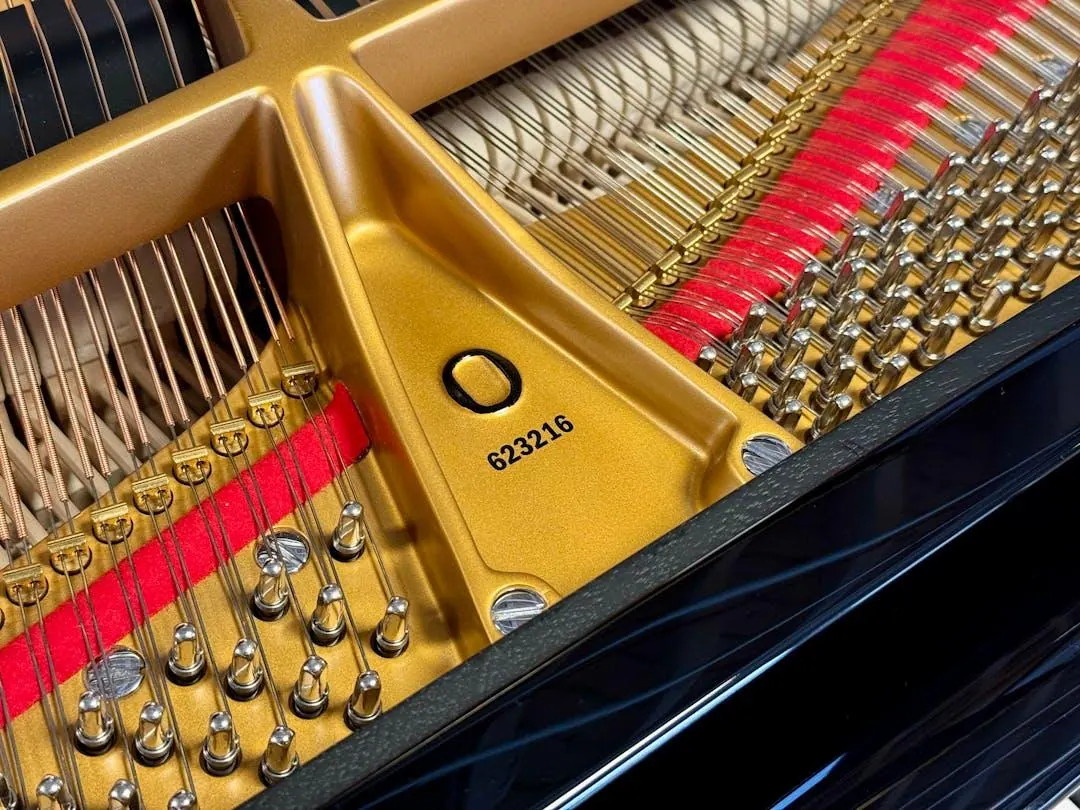
To find out how old a Steinway is, locate the serial number stamped on the piano’s cast-iron plate and match it against a Steinway serial number chart. The chart lists the first serial number of each production year, so the closest year that does not exceed your number is the year your piano was built.
- Locate the serial number. Open the lid of your Steinway and find the serial number stamped into the gold cast-iron plate.
- Match it to the chart. In the Steinway serial number chart below, find the highest serial number that does not exceed yours.
- Read across to the year. The year beside that serial number is your Steinway’s approximate year of manufacture.
Steinway serial numbers mark the approximate beginning of each production year, and a single sequence covers both the New York and Hamburg factories. Treat the result as accurate to within about a year — a Steinway numbered late in one year was often completed in the next.
Where Is the Serial Number on a Steinway Piano?
On a Steinway grand piano
On a Steinway grand piano, the serial number is stamped into the cast-iron plate in the area above the keyboard, between and just behind the tuning pins. Raise the lid and bring a flashlight, angling the beam across the surface — on older Steinway grands, a century of dust and polish can fill the stamping and make it nearly invisible when viewed head-on.
On a Steinway upright piano
On a Steinway upright piano, the serial number is usually stamped on top of the wrest plank — the pinblock — above the cast-iron plate. Lift the top lid and look down. On some Steinway uprights the number appears on the plate itself, just to the right of the tuning pins, or inside the top lid.
What does a Steinway serial number look like?
A Steinway serial number is a standalone figure of roughly three to six digits. It is not the patent dates cast into the plate, the model letter (S, M, O, L, A, B or D), or any long casting number. The model letter tells you the piano’s size; the serial number tells you its age. A credible appraisal needs both, along with whether the instrument came from New York or Hamburg.
Steinway Serial Number Chart by Year (1853–2026)
This Steinway serial number chart covers every production year from 1853 to 2026. Find the closest serial number that does not exceed yours, then read the year beside it.
| Year | Serial No. | Year | Serial No. | Year | Serial No. |
|---|---|---|---|---|---|
| 1853 | 483 | 1919 | 195,000 | 1973 | 431,000 |
| 1856 | 1,000 | 1920 | 200,000 | 1974 | 436,000 |
| 1858 | 2,000 | 1921 | 205,000 | 1975 | 439,000 |
| 1860 | 3,000 | 1922 | 210,000 | 1976 | 445,000 |
| 1861 | 5,000 | 1923 | 217,000 | 1977 | 450,000 |
| 1863 | 7,000 | 1924 | 225,000 | 1978 | 455,500 |
| 1864 | 9,000 | 1925 | 232,000 | 1979 | 463,000 |
| 1865 | 11,000 | 1926 | 240,000 | 1980 | 468,500 |
| 1866 | 13,000 | 1927 | 249,000 | 1981 | 473,500 |
| 1867 | 15,000 | 1928 | 256,000 | 1982 | 478,500 |
| 1868 | 17,000 | 1929 | 263,000 | 1983 | 483,000 |
| 1869 | 19,000 | 1930 | 269,000 | 1984 | 488,000 |
| 1870 | 21,000 | 1931 | 271,000 | 1985 | 493,000 |
| 1871 | 23,000 | 1932 | 274,000 | 1986 | 498,000 |
| 1872 | 25,000 | 1933 | 276,000 | 1987 | 500,000 |
| 1873 | 27,000 | 1934 | 278,000 | 1988 | 504,000 |
| 1874 | 29,000 | 1935 | 279,000 | 1989 | 508,000 |
| 1875 | 31,000 | 1936 | 284,000 | 1990 | 513,000 |
| 1876 | 33,000 | 1937 | 289,000 | 1991 | 517,000 |
| 1877 | 35,000 | 1938 | 290,000 | 1992 | 521,000 |
| 1878 | 40,000 | 1939 | 294,000 | 1993 | 524,000 |
| 1880 | 42,500 | 1940 | 300,000 | 1994 | 527,000 |
| 1881 | 45,000 | 1941 | 305,000 | 1995 | 531,000 |
| 1883 | 50,000 | 1942 | 310,000 | 1996 | 533,500 |
| 1884 | 52,500 | 1943 | 314,000 | 1997 | 538,000 |
| 1885 | 55,500 | 1944 | 316,000 | 1998 | 541,000 |
| 1887 | 60,000 | 1945 | 317,000 | 1999 | 546,000 |
| 1889 | 65,000 | 1946 | 319,000 | 2000 | 550,000 |
| 1890 | 67,500 | 1947 | 322,000 | 2001 | 555,000 |
| 1891 | 70,000 | 1948 | 324,000 | 2002 | 559,000 |
| 1893 | 75,000 | 1949 | 328,000 | 2003 | 563,000 |
| 1894 | 80,000 | 1950 | 331,000 | 2004 | 567,000 |
| 1895 | 82,000 | 1951 | 334,000 | 2005 | 571,000 |
| 1896 | 85,000 | 1952 | 337,000 | 2006 | 574,500 |
| 1898 | 90,000 | 1953 | 340,000 | 2007 | 578,000 |
| 1900 | 95,000 | 1954 | 343,000 | 2008 | 582,000 |
| 1901 | 100,000 | 1955 | 346,500 | 2009 | 584,500 |
| 1902 | 103,000 | 1956 | 350,000 | 2010 | 587,000 |
| 1903 | 106,000 | 1957 | 355,000 | 2011 | 589,500 |
| 1904 | 110,000 | 1958 | 358,000 | 2012 | 592,000 |
| 1905 | 115,000 | 1959 | 362,000 | 2013 | 594,500 |
| 1906 | 120,000 | 1960 | 366,000 | 2014 | 597,500 |
| 1907 | 125,000 | 1961 | 370,000 | 2015 | 600,000 |
| 1908 | 130,000 | 1962 | 375,000 | 2016 | 603,000 |
| 1909 | 135,000 | 1963 | 380,000 | 2017 | 606,500 |
| 1910 | 140,000 | 1964 | 385,000 | 2018 | 608,500 |
| 1911 | 150,000 | 1965 | 390,000 | 2019 | 611,500 |
| 1912 | 155,000 | 1966 | 395,000 | 2020 | 614,000 |
| 1913 | 160,000 | 1967 | 400,000 | 2021 | 617,000 |
| 1914 | 165,000 | 1968 | 405,000 | 2022 | 620,000 |
| 1915 | 170,000 | 1969 | 412,000 | 2023 | 621,800 |
| 1916 | 175,000 | 1970 | 418,000 | 2024 | 625,700 |
| 1917 | 183,000 | 1971 | 423,000 | 2025 | 627,800 |
| 1918 | 190,000 | 1972 | 426,000 | 2026 | 629,300 |
Each figure is the approximate first serial number of that production year, for New York and Hamburg Steinways alike. Some early production runs span more than one year, and published charts differ by a few thousand at certain years. If your number sits within a few hundred of a boundary, confirm it against Steinway & Sons’ own serial number lookup or with a registered piano technician.
A few reference points from the chart: a Steinway with serial number 100,000 was built in 1901, serial number 200,000 in 1920, serial number 300,000 in 1940, serial number 400,000 in 1967, serial number 500,000 in 1987, and serial number 600,000 in 2015.
Now suppose it reads 585,100. That falls between 2009 (584,500) and 2010 (587,000), making it a 2009 Steinway — a modern instrument, likely still on its original strings and hammers, and a very different conversation about maintenance and value.
How Can I Tell If My Steinway Was Made in New York or Hamburg?
To tell whether a Steinway was made in New York or Hamburg, check the fallboard decal and the cast-iron plate. New York instruments are marked “Steinway & Sons, New York”; Hamburg instruments name Hamburg, often alongside other European cities. Both factories draw from the same serial number sequence, which is why one chart dates either origin — but the two are not interchangeable in the market.
Steinway & Sons has built pianos on two continents for well over a century, in Astoria, Queens, and in Hamburg, Germany. The two factories have used different case styling, hardware and voicing traditions over the years, and buyers price them differently. If the markings are ambiguous or the decal has been refinished away, a technician can identify the origin from construction details.
Does an Older Steinway Mean a Better Piano?
An older Steinway is not necessarily a better piano. Age sets your expectations; condition sets the price. A 1912 Model O that spent forty years beside a radiator can be worth a fraction of a 1968 Model L that was tuned twice a year in a climate-stable room.
The Steinway Golden Age: roughly 1900 to 1940
Steinway pianos built between roughly 1900 and 1940 are known as Golden Age instruments, and they are the ones collectors chase. They were made from old-growth timber, on plates cast in Steinway’s own foundry, with a quantity of hand work that would be extraordinarily expensive to reproduce today. A properly rebuilt Golden Age Steinway can hold its own against a new one, frequently at a lower price.
Why the year still matters
Even though age alone does not determine quality, knowing your Steinway’s year of manufacture is genuinely useful in four ways:
- Insurance and appraisal — every valuation starts with year, model and factory of origin.
- Restoration planning — the year tells a technician which internal design to expect. Steinway introduced the Hexagrip pinblock in 1963 and the elastomeric resin bushing in 1976, and both change how a piano is serviced.
- Provenance — factory records and case-history research both begin with the serial number.
- Buying and selling — a seller who cannot produce a serial number cannot substantiate anything else about the instrument.
How Much Is My Steinway Worth?
A Steinway’s value is set by five things, and the serial number only answers the first of them: year of manufacture, model and size, factory of origin, structural condition, and restoration history. Two Steinways built the same week can be worth very different sums depending on how they were stored, how often they were tuned, and whether previous work was done to original specification.
Structural condition is the factor that moves the number most. A technician is assessing whether the pinblock still holds tuning pins at proper torque, whether the soundboard retains its crown and the bridges are uncracked, and how much life is left in the strings, hammers, dampers and action felts.
Restoration history cuts both ways. A detailed rebuild carried out by a highly skilled technician generally supports value, while a piano partially restored by an amateur rebuilder who may have cut corners could be valuable only as a candidate for rebuilding. This is why no realistic valuation can come from a serial number alone — it takes an inspection.
Should I Restore, Sell, or Keep Playing My Steinway?
Once you know your Steinway’s year, three questions decide what happens next. Does the piano still hold a tune from one visit to the next? Are the soundboard, bridges and pinblock sound, or is the instrument losing tension it cannot get back? And what do you want from it — a family piano that plays reliably, a serious practice instrument, or an asset to sell well?
A pre-war Steinway that has never been rebuilt is often worth restoring, because the raw material is better than anything available new at the same money. A mid-century Steinway in good order is usually better served by regulation, voicing and a proper tuning schedule than by a full rebuild. Neither call should be made from a serial number alone.
Get Your Steinway Dated, Valued, or Restored
Westchester Piano is a musician-owned boutique piano showroom in Katonah, New York, with a team of world-class concert technicians on staff. We specialize in Steinway, Mason & Hamlin, Yamaha and Kawai instruments. We serve the tri-state area — New York, New Jersey and Connecticut — with piano tuning, voicing and regulation, full restoration and rebuilding, climate-controlled piano storage, and specialized piano moving.
More Blogs